When your cat is diagnosed with chronic kidney disease, often shortened to CKD, it can feel like someone handed you a map written in fog. You hear terms like IRIS stage, creatinine, SDMA, phosphorus, subcutaneous fluids, renal diet, blood pressure, and anemia. Meanwhile, your cat is sitting there blinking at you like, “Friend, I simply requested dinner.”
CKD can feel overwhelming because it is not one single problem. It is a whole little weather system moving through your cat’s body. Appetite, weight, hydration, blood pressure, phosphorus, potassium, anemia, nausea, gut health, and quality of life can all become part of the story. That is why the biggest mistakes in CKD are often not dramatic mistakes. They are timing mistakes. Sequence mistakes. “Wait and see” mistakes. Missing-the-obvious-because-the-lab-report-looked-complicated mistakes.
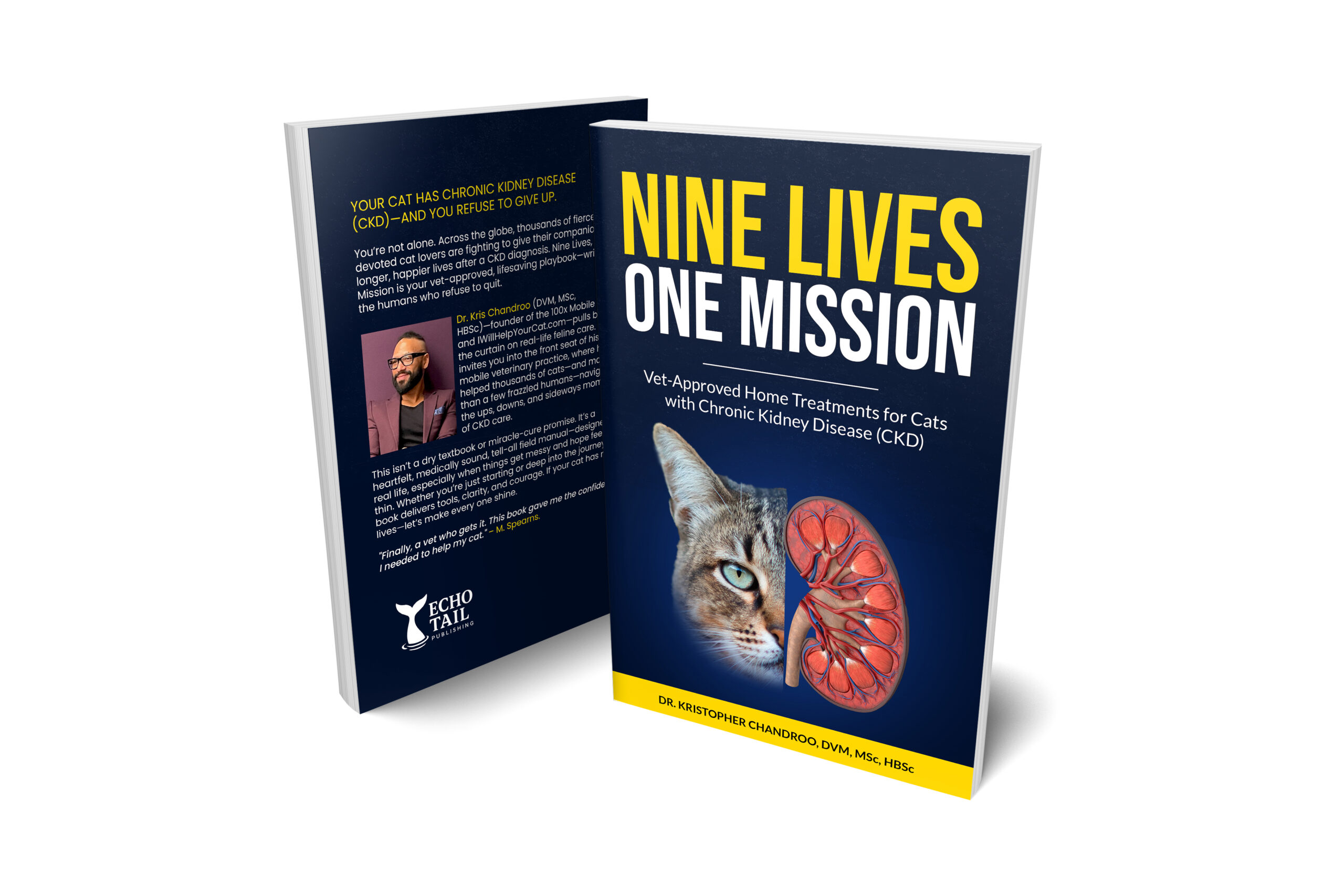
In my book, Nine Lives, One Mission: Vet-Approved Home Treatments for Cats with Chronic Kidney Disease I explain CKD care as a mission: help your cat feel better, slow CKD where possible, and organize the plan so we can understand
your cat’s true health potential.
So let’s talk about five common CKD mistakes cat owners make, and how to avoid them.
Mistake #1: Thinking the CKD Stage Is the Whole
Treatment Plan
Your cat is not a CKD stage. Say it again for the people in the back, and also for the cat currently refusing the renal food:
Your cat is not a CKD stage.
IRIS staging is useful. Bloodwork is useful. Urine testing is useful. These tools help us understand where your cat may be on the CKD map. But a stage is not a treatment plan.
A stage does not tell me whether your cat is:
- Eating enough
- Losing muscle
- Nauseous
- Constipated
- Hiding
- Painful
- Stressed
- Dehydrated
- Hypertensive
- Anemic
- Quietly turning into a furry little skeleton under a beautiful coat
CKD care has to be built around the cat in front of us.
A Stage 2 cat who is losing weight and refusing food may need more urgent support than a Stage 3 cat who is stable, eating, hydrated, and maintaining weight. The mistake is thinking the number gives you the whole story. It does not.
The better question is:
What does this specific cat need next? That is where real CKD care begins
Mistake #2: Waiting Too Long to Protect Body Weight
In CKD, weight loss is not a side note. It is the alarm bell.
Cats are masters at hiding change. They can lose muscle quietly under all that fluff. One day you are petting them and suddenly think, “Wait. Were these hips always this pointy?”
That moment matters.
In my book, I introduce the BITE Strategy for CKD cats: Body weight and Intestinal health for Toxin Elimination. Body weight comes first because a cat who is losing weight is losing the very fuel they need to cope with illness.
When a CKD cat is losing weight, we need to act. Not panic. Act.
That may mean:
- Tracking weight at home with a baby scale or pet scale
- Discussing appetite support
- Treating nausea
- Rethinking the food plan
- Checking whether another disease is also crashing the party
The mistake is waiting until weight loss becomes obvious from across the room. By then, the cat may already be deep into malnutrition. And malnutrition is not just “thinness.” It affects muscle, immunity, appetite, mobility, healing, and resilience. A CKD cat needs calories before they need perfection.
Which brings us to the next mistake.
Mistake #3: Worshipping the “Perfect” Kidney Diet While the Cat Eats Nothing
Prescription renal diets can be incredibly useful. They can help manage phosphorus, support kidney health, and become an important part of CKD care.
But there is one tiny problem.
The cat has to eat it.
This is where many loving, committed owners get trapped. They are told the renal diet matters. So they offer the renal diet. The cat sniffs it, blinks, and walks away like a restaurant critic with unresolved childhood issues.
Then the owner waits:
- Maybe tomorrow.
- Maybe a different flavour.
- Maybe if I warm it up.
- Maybe if I plead.
- Maybe if I place it in the moonlight and whisper “kidney support” three times.
Meanwhile, the cat eats less. And loses weight. And feels worse.
In early CKD management, calories often come before diet perfection.
A renal diet sitting untouched in the bowl is not treating the cat. It is decorating the kitchen.
The goal is not to abandon kidney diets. The goal is to introduce them wisely.
Sometimes that means:
- A gradual transition
- Mixing a small amount into familiar food
- Stabilizing appetite first, then refining the diet later
- Saying, “Right now, this cat needs to eat.”
Food your cat reliably eats is often better than perfect food your cat refuses.
Your cat cannot heal from a menu. They need fuel.
Mistake #4: Missing Phosphorus, Potassium, and Hydration
CKD is not just “high kidney values.” It is a system problem.
And three common troublemakers deserve attention:
- Phosphorus
- Potassium
- Hydration
Phosphorus can make CKD cats feel awful when it gets too high. It can suppress appetite, contribute to nausea, and become part of the bigger kidney-damage conversation.
The mistake is assuming “normal” always means “ideal.” For many CKD cats, we are not just asking whether phosphorus is technically inside the lab range. We are asking whether it is in the range that gives the cat the best chance to feel better and maintain stability.
Then there is potassium.
Low potassium can be easy to miss. A cat may seem weak, tired, dull, or not quite right. The signs can overlap with CKD itself, which is why it can be overlooked. Sometimes potassium is the quiet little mineral holding the whole fragile image together.
And then hydration.
Some CKD cats need subcutaneous fluids. Some do not. Some need them temporarily. Some need them long term. Some refuse the whole production and file an official complaint with claws. But hydration matters. Dehydration can worsen how a cat feels, affect appetite, contribute to constipation, and make bloodwork harder to interpret.
The mistake is treating CKD as one number instead of a moving system.
A good CKD plan asks:
- Is the cat eating?
- Is the cat maintaining weight?
- Is phosphorus controlled?
- Is potassium okay?
- Is hydration adequate?
- Is constipation present?
- Is nausea controlled?
- Is the cat actually feeling better?
That is the work. Not glamorous. Very important.
Tiny kidney accountant work.
Mistake #5: Forgetting Blood Pressure, Anemia, and the “Other Stuff”
CKD loves company. It does not always arrive alone. Older cats with CKD may also have high blood pressure, anemia, arthritis, hyperthyroidism, dental disease, pancreatitis, inflammatory bowel disease, constipation, or nausea.
Sometimes CKD gets blamed for everything:
- The cat is weak? CKD.
- Not eating? CKD.
- Wobbly? CKD.
- Losing weight? CKD.
- Staring at the wall like they just remembered an unpaid debt from 2007? Probably CKD.
But not always.
High blood pressure is a big one. Cats with CKD can develop hypertension, and hypertension can affect the eyes, brain, heart, and kidneys. It is one of those things that can be missed if we do not look for it.
Anemia is another. The kidneys help signal the body to make red blood cells. When CKD progresses, some cats become anemic. These cats may seem tired, weak, or less engaged.
And pain matters too. An arthritic CKD cat may not be “slowing down because of kidneys.” They may be sore. A nauseous CKD cat may not be “picky.” They may feel sick. A constipated CKD cat may not be “just old.” They may need help.
The mistake is building a kidney plan while forgetting the rest of the cat. The kidneys are important, but they are attached to an entire cat. And that cat has opinions, habits, pain thresholds, preferences, routines, and a body full of other systems trying to keep up.
The Better Way: Build a CKD Plan in the Right Order
The goal is not to throw every supplement, food, medication, and fluid bag at your cat by Friday. That is not a plan. That is a confetti cannon.
The goal is to organize CKD care so each step makes sense.
Start with the basics:
- Is your cat eating enough?
- Are they maintaining weight?
- Are they hydrated?
- Is phosphorus controlled?
- Is potassium okay?
- Do they need their blood pressure checked?
- Are they nauseous?
- Are they constipated?
- Are they painful?
- Are we missing another condition?
Then we build carefully, kindly, and with the cat’s cooperation whenever possible.
Because CKD care is not just about extending life. It is about preserving the life your cat actually wants to live:
- Eating
- Drinking
- Purring
- Grooming
- Sleeping in the good spot
- Bossing around the household
- Judging your choices from the armchair
- Still being themselves
That is the mission.
Want the Full CKD Roadmap?
If your cat has been diagnosed with chronic kidney disease, you do not have to figure this out from scattered internet posts, late-night searches, and well-meaning advice that may not apply to your cat.
I wrote Nine Lives, One Mission: Vet-Approved Home Treatments for Cats with Chronic Kidney Disease to give cat owners a clearer, kinder, more organized way to understand CKD care.
It walks through the bigger picture:
- Weight
- Appetite
- Phosphorus
- Potassium
- Hydration
- Anemia
- Blood pressure
- Gut health
- The real-life decisions that come with caring for a CKD cat
Read the book if you want a practical CKD roadmap you can understand and discuss with your veterinary team.
And if you want help building a plan for the cat in front of you, book a home visit with 100x Mobile Vet.
At 100x Mobile Vet, we help cats with CKD receive thoughtful veterinary care at home, where we can slow things down, look at the full picture, and build a plan that fits your cat’s body, your home, and what is actually possible.
Because your cat is not a kidney value. Your cat is not a stage. Your cat is a whole little creature with a spark still worth protecting.
Dr. Kris